In his latest novel,Call From the Jailhouse, Rick Novak masterfully crafts a captivating legal thriller that delves deep into the intricate dynamics of love, ambition, and the blurred lines between justice and personal desires.
As the narrative unfolds, readers are introduced to Sam Vella, an attractive anesthesiologist who has recently experienced a divorce from his gorgeous and brilliant Cicely Jackson Vella, a prominent defense attorney based in San Francisco. Cicely has a bachelor’s degree from Harvard, a law degree from Yale, and a former title of Miss New Hampshire.
The story takes off with a frantic phone call from Sam to Cicely, delivering the astonishing news that he finds himself incarcerated in San Mateo County jail, facing a murder accusation.
After some self-reflection, Cicely agrees to help Sam, and her decision marks the onset of a thrilling legal drama where justice and love intersect in a precarious dance.
The story rewinds and takes us back six months to Sam’s life, unexpectedly veering down a new and consequential path, which we soon realize has profound consequences. We delve into how Sam was caught in a passionate yet forbidden affair with Scarlett, an alluring, married woman whose husband is a billionaire.
The narrative turns dramatically in the novel’s final chapters, zeroing in on Sam’s unexpected entanglement in a high-profile murder trial. The story delves into the complex web of a multi-million-dollar double homicide case infused with desire, wealth, intrigue, and scandal. And as the pages unfold, we find ourselves immersed in riveting courtroom proceedings, where the stakes are high, and the tension is palpable. And just when you think you’ve seen it all, be prepared for an unexpected and jaw-dropping twist that will keep you on the edge of your seat.
Novak skillfully explores love, ambition, and the complex interplay between justice and personal desires. The central characters Sam and Cicely undergo profound transformations. Sam’s journey from beleaguered anesthesiologist to unjustly accused murder suspect showcases Novak’s talent for crafting multi-dimensional characters.
Call From the Jailhouseis a must-read for legal thriller fans, offering emotional depth, intricate character development, and surprising revelations, leaving readers eagerly anticipating Rick Novak’s next literary masterpiece.
Rick Novak’s third novel, Call From the Jailhouse, a 5-star review from the San Francisco Book Review, is now available on Amazon:
FROM THE SAN FRANCISCO BOOK REVIEW:
Call From the Jailhouse
By Rick Novak Extasy Books, 331 pages, Format: eBook and paperback
Star Rating: 5 / 5
Author Rick Novak, MD, does an exquisite job of crafting a scenario in which a man is accused of murdering his lover and her husband and brings it all the way into a full jury trial. Call From the Jailhouse introduces readers to top defense attorney Cicely Vella. Cicely is a savage in the courtroom and is able to present to the jury all the reasons why they should acquit. Cicely’s marriage to an anesthesiologist named Sam Vella ended in divorce almost a year and a half ago, although there were certainly times when she missed him. When Sam calls Cicely from the county jail and tells her he is being accused of murder, Cicely knows she must defend him. Although their marriage didn’t work out, Cicely knows Sam didn’t kill anyone.
I loved the way the book was crafted. It starts with the phone call and then goes back in time six months to tell the readers about how Sam meets his married lover, Scarlett. The story is carefully told, with no important detail left out. As a San Francisco Bay Area native, I loved that I knew where so many of the referenced places were, including the Pacific Athletic Club (now The Bay Club), the Stanford Dish, and Kings Mountain Road. I admit that I looked up the Mahogany, where Sam meets Scarlett, and as I guessed, there was no such place listed. It seemed like it could have been modeled after the Rosewood Hotel in Menlo Park.
Call From the Jailhouse moves at the perfect pace. As Sam and Scarlett’s secret relationship starts to bloom, Sam finds himself falling in love with her even though she treats him like she owns him. So, how does Sam find himself accused of murder?
The last half of the book is dedicated to Cicely defending Sam in court. All evidence seems to lead to Sam, even though most of it is circumstantial. They say, write what you know, so Novak’s extensive knowledge in the medical field allows him to cleverly insert medical references, such as a medicine used to paralyze patients to allow doctors to insert a breathing tube. It’s details such as this that give the readers a full understanding of the events that take place in the book.
The court case is my favorite part of the book. This is also where there is a huge twist in the plot that gets uncovered. Cicely is a fantastic attorney who has integrity, grit, and grace all rolled into one small Black woman. Sam is a romantic at heart who finds himself in a black widow’s web. Call From the Jailhouse has fabulous characters, beautiful backdrops, and a plot that will pull you closer with every page.
Reviewed by Kristi Elizabeth
OUR STAR RATING SYSTEM 5 stars: Reviewer considers the book to be something that everyone should read. Reviewer would definitely read it again.
*
*
CALL FROM THE JAILHOUSE excerpt:
Chapter One: The Call
Cicely Vella’s receptionist announced, “Ms. Vella, your ex-husband is on line one. He says he’s in jail. He wants to talk to you.”
There are mileposts in life—moments that alter the future in earthshattering ways. The sudden change can be terrific or tragic. Cicely used to think her defining moment was the end of her marriage, but instead her defining moment occurred when she picked up line one and said, “Sam, what’s going on?”
His voice came through pressured and loud, so robust she had to hold the phone six inches away from her ear. “There’s been some kind of mistake,” he said. “The police arrested me. I’m in trouble.”
Cicely was shocked. Sam had never called her since their divorce, and she’d never heard this tone in his voice. He’d always been cool, calm, and controlled, even in the most stressful times. Cicely couldn’t hide her alarm. “Arrested you for what?”
“Murder.”
Cicely almost dropped the phone. “Murder? You’ve got to be kidding. Where are you right now?”
“The San Mateo County Jail. I need a defense attorney. I need you. Please help me.”
Cicely pictured Sam Vella sitting alone in a jail cell, and her response surprised her. She leapt out of her chair, ready to go to him. “I’ll be there in twenty minutes,” she said. “And don’t answer any questions from anyone until I arrive. Got that?”
“I won’t. And thank you so much for doing this for me.”
“I haven’t done anything yet.” Cicely hung up the phone, feeling the room spinning around her. This wasn’t possible. Sam was a smart guy—an altruistic medical doctor who simply couldn’t kill anyone. He’d been a flawed husband, a man who never quite got used to his overachieving wife’s career eclipsing his, but he wasn’t wired to commit violent crime. Cicely grabbed her purse and car keys and headed for the door. A petite Black woman, Cicely wore a gray wool pantsuit and a Brooks Brothers white cotton shirt. Her androgynous attire was her statement that, in the male-dominated world of litigating attorneys, she had the power to match up with her masculine opponents. Her business—the world of defendants and their alleged misdeeds—was a grim reality of treachery, deceit, ruses, and lies. Cicely didn’t see her vocation as a quest for truth, but rather a competition in search of victory. It was her job to conjure deception. Her joy came from constructing any reasonable alternative to the allegations of the prosecution. Every new case was a puzzle with a yet undiscovered solution. Finding that solution was the most enjoyable pastime Cicely had ever discovered. The money was good, but she knew in her heart she might even have done it for free.
It was that fun.
As Cicely exited through the waiting room, her receptionist said, “I overheard your conversation with Sam. Are you going to defend him?”
“Hell, yes. What kind of defense attorney would I be if my ex-husband spent the rest of his life rotting in prison as a convicted murderer?”
“You’ll be center stage if you defend him.”
“I’ll be center stage whether I’m his lawyer or not. We share a last name. We share a past. I’m going to the jail. I don’t know when I’ll be back.” Cicely’s thoughts were in turmoil. Her divorce was fresh—only one year old. After five workaholic years as man and wife, she and Sam painted themselves into two distant corners—a sad California career-trumps-love divorce. She’d pulled the plug on their marriage and concentrated on climbing to the pinnacle of the legal world. Cicely had only seen Sam twice since the divorce, and each time she felt the same two opposing emotions―a strong attraction to his physical presence, and sadness that the man who had once been her best friend was a stranger to her now.
Cicely knew the drive from her office to the jail very well. She met most of her clients for the first time within those very walls. Minutes later she sat face-to-face with Sam in a windowless white-walled room. He wore an orange jumpsuit with the number 71427 scrolled across his chest. His hair was parted in the middle, lanky and wet, as if he’d just stepped out of a storm, and his gaze never left Cicely. Her heart raced to be sitting so close to him again. He looked as vulnerable as a lost puppy and as breathtaking as any man she had ever set eyes on. Cicely skipped any pleasantries and started with the obvious question, “Who are you accused of killing, Sam?”
He shook his head and dropped his stare toward the table separating them. Then his eyes flicked upward for a second, partially hidden below thick hooded brows, and he said, “It was this woman I was dating. They claim I killed her. And they claim I killed her husband, too.”
“Two murders? Good God.” Cicely exhaled mightily. “Tell me what happened, starting when you first met this-this woman.” Cicely balanced her pen over an 8.5 X 14-inch yellow legal pad and prepared to chronicle Sam’s story.
“Her name was Scarlett,” Sam said. “It all started one rainy January night last winter…”
*
CALL FROM THE JAILHOUSE: NOW AVAILABLE ON AMAZON LINK:
Litigator Cicely Vella’s ex-husband is arrested for a double murder, and asks her to be his defense lawyer. Cicely rarely loses a case, but her extraordinary record is in jeopardy when she chooses to defend Sam Vella, the only suspect in what appear to be two indefensible crimes.
Cicely is living the dream life of a young professional. She’s bright, beautiful, Black, and successful, but she harbors one weakness—lingering feelings for Sam, the husband who got away.
Samuel Vella is a physician with high intellect, striking good looks, and a proclivity for making poor decisions. In the aftermath of his split from Cicely, Sam initiates an affair with Scarlett Lang, a free-spirited married woman, and their liaison lands Sam behind bars.
After receiving Sam’s call from the jailhouse, Cicely feels the triple lures of her emotional attachment to her ex-husband, the opportunity to redeem the Vella name in the courtroom, and her zest for fame in this sensational high-profile trial. Nothing in the world but this court date could make Cicely and Sam sit elbow to elbow, day after day.
The odds of a divorced couple remarrying the same person are 6 in 100, a statistic Cicely is both aware of and wary of, as she’s drawn back into Sam’s life.
*
*
CALL FROM THE JAILHOUSE excerpt:
Chapter One: The Call
Cicely Vella’s receptionist announced, “Ms. Vella, your ex-husband is on line one. He says he’s in jail. He wants to talk to you.”
There are mileposts in life—moments that alter the future in earthshattering ways. The sudden change can be terrific or tragic. Cicely used to think her defining moment was the end of her marriage, but instead her defining moment occurred when she picked up line one and said, “Sam, what’s going on?”
His voice came through pressured and loud, so robust she had to hold the phone six inches away from her ear. “There’s been some kind of mistake,” _he said. “The police arrested me. I’m in trouble.”
Cicely was shocked. Sam had never called her since their divorce, and she’d never heard this tone in his voice. He’d al-ways been cool, calm, and controlled, even in the most stressful times. Cicely couldn’t hide her alarm. “Arrested you for what?”
“Murder.”
Cicely almost dropped the phone. “Murder? You’ve got to be kidding. Where are you right now?”
“The San Mateo County Jail. I need a defense attorney. I need you. Please help me.”
Cicely pictured Sam Vella sitting alone in a jail cell, and her response surprised her. She leapt out of her chair, ready to go to him. “I’ll be there in twenty minutes,” she said. “And don’t answer any questions from anyone until I arrive. Got that?”
“I won’t. And thank you so much for doing this for me.”
“I haven’t done anything yet.” Cicely hung up the phone, feeling the room spinning around her. This wasn’t possible. Sam was a smart guy—an altruistic medical doctor who simply couldn’t kill anyone. He’d been a flawed husband, a man who never quite got used to his overachieving wife’s career eclipsing his, but he wasn’t wired to commit violent crime. Cicely grabbed her purse and car keys and headed for the door. A petite Black woman, Cicely wore a gray wool pantsuit and a Brooks Brothers white cotton shirt. Her androgynous attire was her statement that, in the male-dominated world of litigating attorneys, she had the power to match up with her masculine opponents. Her business—the world of defendants and their alleged misdeeds—was a grim reality of treachery, deceit, ruses, and lies. Cicely didn’t see her vocation as a quest for truth, but rather a competition in search of victory. It was her job to conjure deception. Her joy came from constructing any reasonable alternative to the allegations of the prosecution. Every new case was a puzzle with a yet undiscovered solution. Finding that solution was the most enjoyable pastime Cicely had ever discovered. The money was good, but she knew in her heart she might even have done it for free.
It was that fun.
As Cicely exited through the waiting room, her receptionist said, “I overheard your conversation with Sam. Are you going to defend him?”
“Hell, yes. What kind of defense attorney would I be if my ex-husband spent the rest of his life rotting in prison as a convicted murderer?”
“You’ll be center stage if you defend him.”
“I’ll be center stage whether I’m his lawyer or not. We share a last name. We share a past. I’m going to the jail. I don’t know when I’ll be back.” Cicely’s thoughts were in turmoil.
Her divorce was fresh—only one year old. After five workaholic years as man and wife, she and Sam painted themselves into two distant corners—a sad California career-trumps-love divorce. She’d pulled the plug on their marriage and concentrated on climbing to the pinnacle of the legal world. Cicely had only seen Sam twice since the divorce, and each time she felt the same two opposing emotions―a strong attraction to his physical presence, and sadness that the man who had once been her best friend was a stranger to her now.
Cicely knew the drive from her office to the jail very well. She met most of her clients for the first time within those very walls. Minutes later she sat face-to-face with Sam in a windowless white-walled room. He wore an orange jumpsuit with the number 71427 scrolled across his chest. His hair was parted in the middle, lanky and wet, as if he’d just stepped out of a storm, and his gaze never left Cicely. Her heart raced to be sitting so close to him again. He looked as vulnerable as a lost puppy and as breathtaking as any man she had ever set eyes on. Cicely skipped any pleasantries and started with the obvious question, “Who are you accused of killing, Sam?”
He shook his head and dropped his stare toward the table separating them. Then his eyes flicked upward for a second, partially hidden below thick hooded brows, and he said, “It was this woman I was dating. They claim I killed her. And they claim I killed her husband, too.”
“Two murders? Good God.” Cicely exhaled mightily. “Tell me what happened, starting when you first met this-this woman.” Cicely balanced her pen over an 8.5 X 14-inch yellow legal pad and prepared to chronicle Sam’s story.
“Her name was Scarlett,” Sam said. “It all started one rainy January night last winter…”
My name is Rick Novak, and I’m a double-boarded anesthesiologist and internal medicine doctor and a medical fiction author. I’m here to talk about Doctor Vita, a vision of the future of Artificial Intelligence in Medicine.
Doctor Vita is a satire of technology in medicine, and what might happen if Artificial Intelligence and robotics were allowed to be in complete and total control of our medical care.
I’m an Adjunct Clinical Professor of Anesthesiology, Perioperative and Pain Medicine at Stanford and the Deputy Chief of the department. I don’t tout myself as an expert in AI technology, but I’m an expert in taking care of patients, which I’ve done in clinics, operating rooms, intensive care units, and emergency rooms at Stanford and in Silicon Valley for over 40 years.
AI is already prevalent in our daily life. Smartphones verbally direct us to our destination through mazes of highways and traffic. Self-driving cars are in advanced testing phases. The Amazon Echo brings us Alexa, an AI-powered personal assistant who follows verbal commands in our homes.Artificial intelligence in medicine (AIM) will grow in importance in the decades to come and will change anesthesia practice, surgical practice, perioperative medicine in clinics, and the interpretation of imaging. AI is already prevalent in our daily life. Smartphones verbally direct us to our destination through mazes of highways and traffic. Self-driving cars are in advanced testing phases. The Amazon Echo brings us Alexa, an AI-powered personal assistant who follows verbal commands in our homes. AIM advances are paralleling these inventions in three clinical arenas:
Surgical Robot
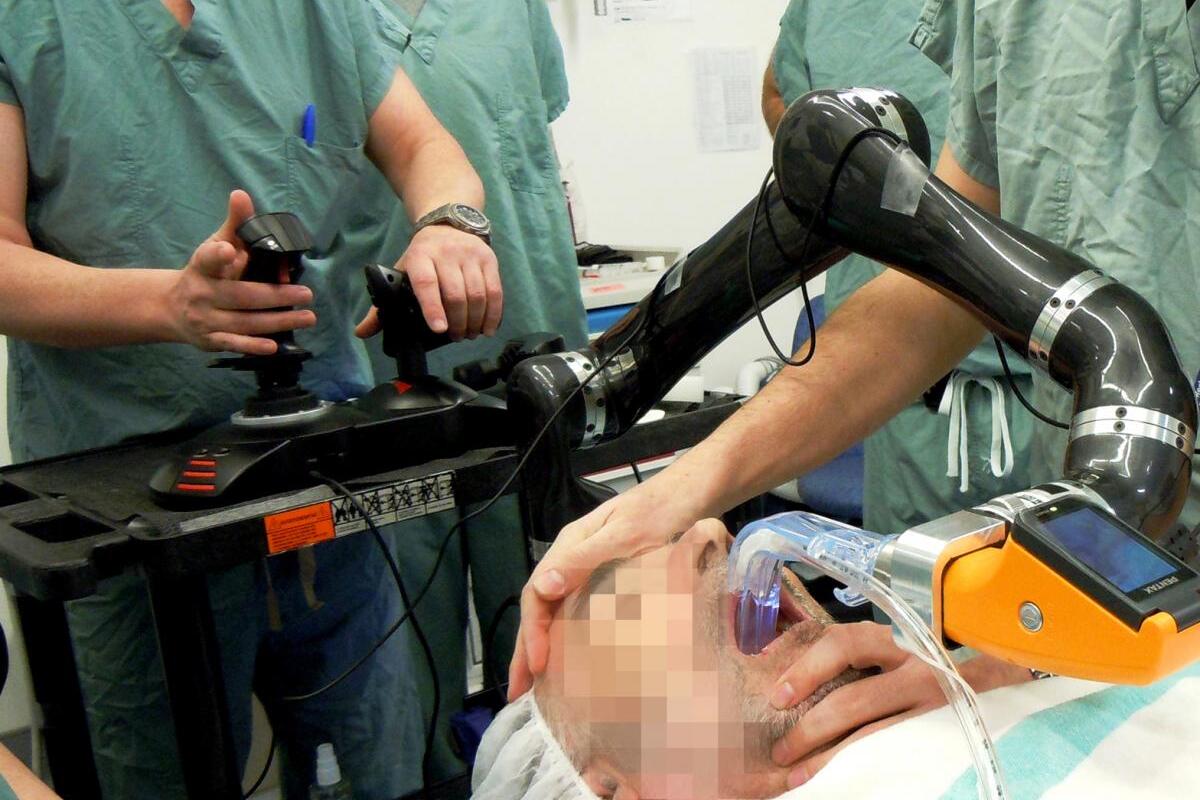
1. Operating rooms: Anesthesia robots fall into two groups: manual robots and pharmacological robots. Manual robots include the Kepler Intubation System intubating robot:
designed to utilized video laryngoscopy and a robotic arm to place an endotracheal tube, the use of the DaVinci surgical robot to perform regional anesthetic blockade, and the use of the Magellan robot to place peripheral nerve blocks.
Magellan robot for placing regional anesthetic blocks
Pharmacological robots include the McSleepy intravenous sedation machine, designed to administer propofol, narcotic, and muscle relaxant:
and the iControl-RP machine, described in The Washington Post as a closed-loop system intravenous anesthetic delivery system which makes its own decisions regarding the IV administration of remifentanil and propofol. This device monitors the patient’s EEG level of consciousness via a BIS monitor device as well as traditional vital signs. One of the machine’s developers, Mark Ansermino MD stated, “We are convinced the machine can do better than human anesthesiologists.” The current example of surgical robot technology in the operating room is the DaVinci operating robot. This robot is not intended to have an independent existence, but rather enables the surgeon to see inside the body in three dimensions and to perform fine motor procedures at a higher level. The good news for procedural physicians is that it’s unlikely any AIM robot will be able to independently master manual skills such as complex airway management or surgical excision. No device on the horizon can be expected to replace anesthesiologists. Anesthetizing patients requires preoperative assessment of all medical problems from the history, physical examination, and laboratory evaluation; mask ventilation of an unconscious patient; placement of an airway tube; observation of all vital monitors during surgery; removal of the airway tube at the conclusion of most surgeries; and the diagnosis and treatment of any complication during or following the anesthetic.
IBM Watson AI Robot
2. Clinics: In a clinic setting a desired AIM application would be a computer to input information on a patient’s history, physical examination, and laboratory studies, and via deep learning establish a diagnosis with a high percentage of success. IBM’s Watson computer has been programmed with over 600,000 medical evidence reports, 1.5 million patient medical records, and two million pages of text from medical journals. Equipped with more information than any human physician could ever remember, Watson is projected to become a diagnostic machine superior to any doctor. AIM machines can input new patient information into a flowchart, also known as a branching tree. A flowchart will mimic the process a physician carries out when asking a patient a series of increasingly more specific questions. Once each diagnosis is established with a reasonable degree of medical certainty, an already-established algorithm for treatment of that diagnosis can be applied. Because anesthesiology involves preoperative clinic assessment and perioperative medicine, the role of AIM in clinics is relevant to our field.
Artificial Intelligence and X-ray Interpretation
3. Diagnosis of images: Applications of image analysis in medicine include machine learning for diagnosis in radiology, pathology, and dermatology. The evaluation of digital X-rays, MRIs, or CT scans requires the assessment of arrays of pixels. Future computer programs may be more accurate than human radiologists. The model for machine learning is similar to the process in which a human child learns–a child sees an animal and his parents tell him that animal is a dog. After repeated exposures the child learns what a dog looks like. Early on the child may be fooled into thinking that a wolf is a dog, but with increasing experience the child can discern with almost perfect accuracy what is or is not a dog. Deep learning is a radically different method of programming computers which requires a massive database entry, much like the array of dogs that a child sees in the example above, until a computer can learn the skill of pattern matching. An AIM computer which masters deep learning will probably not give yes or no answers, but rather a percentage likelihood of a diagnosis, i.e. a radiologic image has a greater than a 99% chance of being normal, or a skin lesion has a greater than 99% chance of being a malignant melanoma. In pathology, computerized digital diagnostic skills will be applied to microscopic diagnose. In dermatology, machine learning will be used to diagnosis skin cancers, based on large learned databases of digital photographs. Imaging advances will not directly affect anesthesiologists, but if you’re a physician who makes his or her living by interpreting digital images, you should have real concern about AIM taking your job in the future.
There’s currently a shortage of over seven million physicians, nurses and other health workers worldwide. Can AIM replace physicians? Contemplate the following . . .
All medical knowledge is available on the Internet:
Most every medical diagnosis and treatment can be written as a decision tree algorithm:
Voice interaction software is excellent:
The physical exam is of less diagnostic importance than scans and lab tests which can be digitalized:
Computers are cheaper than the seven-year post-college education required to train a physician:
versus an inexpensive computer:
There is a need for cheaper, widespread healthcare, and the concept of an automated physician is no longer the domain of science fiction. Most sources project an AIM robot doctor will likely look like a tablet computer. For certain applications such as clinical diagnosis or new image retrieval, the AIM robot will have a camera, perhaps on a retractable arm so that the camera can approach various aspects of a patient’s anatomy as indicated. Individual patients will need to sign in to the computer software system via retinal scanners, fingerprint scanners, or face recognition programs, so that the computer can retrieve the individual patient’s EHR data from an Internet cloud. It’s possible individual patients will be issued a card, not unlike a debit or credit card, which includes a chip linking them to their EHR data.
What will be the economics of AI in medicine? Who will pay for it? America spends 17.8% of its Gross National Product on healthcare, and this number is projected to reach 20% by 2025. Entrepreneurs realize that healthcare is a multi-billion dollar industry, and the opportunity to earn those healthcare dollars is alluring.
It’s inevitable that AI will change current medical practice. Vita is the Latin word for “life.” I’ve coined the name “Doctor Vita” for the AI robot which will someday do many of the tasks currently managed by human physicians.
These machines will breathe new life into our present healthcare systems. In all likelihood these improvements will be more powerful and more wonderful than we could imagine. A bold prediction: AI will change medicine more than any development since the invention of anesthesia in 1849. Doctor Vita from All Things That Matter Press describes a fictional University of Silicon Valley Medical Center staffed by both AI doctors and human doctors. How physicians interact with these machines will be a leading question for our future. AI in medicine will arrive in decades to come. Michael Crichton wrote Jurassic Parkin 1990, 29 years ago, and we still do not see genetically recreated dinosaurs roaming the Earth. But we will see AI in medicine within 29 years. You can bet on it.
Here’s a dilemma: In 2018 and 2019 autopilots drove two Boeing 737 Max airplanes to crashes despite the best efforts of human pilots to correct their course. To date there have been 3 deaths of drivers in self-driving Tesla automobiles. What will happen when AI intersects with medicine and we have machines directing medical care? In the spirit of Jules Verne, this century’s trip around the world, to the center of the earth, to the moon, or beneath the ocean’s surface is the coming of Artificial Intelligence in Medicine.
Once again Rick Novak serves up a virulent novel that addresses an ongoing change in medicine that worries most of us – the growing dependence on robotics in surgery and the dehumanization of medicine: doctor patient interaction is altered by EMR and IT reporting of visits to insurance companies and the warmth of communication suffers. Rick takes this information to create a story about the extremes of AI in the form of a glowing globe that is Dr Vita and the struggle computer scientist/anesthesiologist Dr Lucas assumes as he tries to save medicine from the extremes of the ‘new age’ called FutureCare. As expected, Rick’s recreation of the tension in the OR and in interaction of the physicians is on target: his own experiences enhance the veracity of the story’s atmosphere.
Rick Novak writes so extremely well that likely has answered the plea of his readers to continue this `hobby’. He is becoming one of the next great American physician authors – think William Carlos Williams, Theodore Isaac Rubin, Oliver Wolf Sacks, Richard Selzer, and also the Brits Oliver Wendell Holmes et al. Medicine and writing can and do mix well in hands as gifted as Rick Novak. Highly Recommended. Grady Harp, April 19
On June 5, 2019 the Almanac, the home newspaper for the California communities of Menlo Park, Atherton, Portola Valley and Woodside featured a cover story on Rick Novak and his new novel Doctor Vita.
Dr. Rick Novak poses for a portrait at Stanford Hospital in Palo Alto, May 23. Photo by Magali Gauthier/The Almanac
Between his time in the operating room, teaching, and raising his three sons, Atherton resident Dr. Rick Novak has found time to write two novels.
Novak, 65, an anesthesiologist at the Waverley Surgery Center in Palo Alto, recently published his latest, “Doctor Vita,” a story about an artificial intelligence (AI) physician module that goes awry.
It’s a science fiction novel that explores how technological breakthroughs like artificial intelligence and robots will affect medical care — and already have.
Artificial intelligence in medicine (AIM) will grow in importance in the decades to come and will change anesthesia practice, surgical practice, perioperative medicine in clinics, and the interpretation of imaging. AI is already prevalent in our daily life. Smartphones verbally direct us to our destination through mazes of highways and traffic. Self-driving cars are in advanced testing phases. The Amazon Echo brings us Alexa, an AI-powered personal assistant who follows verbal commands in our homes. AIM advances are paralleling these inventions in three clinical arenas:
1. Operating rooms: Anesthesia robots fall into two groups: manual robots and pharmacological robots. Manual robots include the Kepler Intubation System intubating robot, designed to utilized video laryngoscopy and a robotic arm to place an endotracheal tube [1], the use of the DaVinci surgical robot to perform regional anesthetic blockade [2], and the use of the Magellan robot to place peripheral nerve blocks [3,4]. Pharmacological robots include the McSleepy intravenous sedation machine, designed to administer propofol, narcotic, and muscle relaxant [5], and the iControl-RP machine, described in The Washington Postas a closed-loop system intravenous anesthetic delivery system which makes its own decisions regarding the IV administration of remifentanil and propofol [6]. This device monitors the patient’s EEG level of consciousness via a BIS monitor device as well as traditional vital signs [7]. One of the machine’s developers, Mark Ansermino MD stated, “We are convinced the machine can do better than human anesthesiologists.” The current example of surgical robot technology in the operating room is the DaVinci operating robot. This robot is not intended to have an independent existence, but rather enables the surgeon to see inside the body in three dimensions and to perform fine motor procedures at a higher level. The good news for procedural physicians is that it’s unlikely any AIM robot will be able to independently master manual skills such as complex airway management or surgical excision. No device on the horizon can be expected to replace anesthesiologists. Anesthetizing patients requires preoperative assessment of all medical problems from the history, physical examination, and laboratory evaluation; mask ventilation of an unconscious patient; placement of an airway tube; observation of all vital monitors during surgery; removal of the airway tube at the conclusion of most surgeries; and the diagnosis and treatment of any complication during or following the anesthetic.
2. Clinics: In a clinic setting a desired AIM application would be a computer to input information on a patient’s history, physical examination, and laboratory studies, and via deep learning establish a diagnosis with a high percentage of success. IBM’s Watson computer has been programmed with over 600,000 medical evidence reports, 1.5 million patient medical records, and two million pages of text from medical journals [8]. Equipped with more information than any human physician could ever remember, Watson is projected to become a diagnostic machine superior to any doctor. AIM machines can input new patient information into a flowchart, also known as a branching tree. A flowchart will mimic the process a physician carries out when asking a patient a series of increasingly more specific questions. Once each diagnosis is established with a reasonable degree of medical certainty, an already-established algorithm for treatment of that diagnosis can be applied. Because anesthesiology involves preoperative clinic assessment and perioperative medicine, the role of AIM in clinics is relevant to our field.
3. Diagnosis of images: Applications of image analysis in medicine include machine learning for diagnosis in radiology, pathology, and dermatology. The evaluation of digital X-rays, MRIs, or CT scans requires the assessment of arrays of pixels. Future computer programs may be more accurate than human radiologists. The model for machine learning is similar to the process in which a human child learns–a child sees an animal and his parents tell him that animal is a dog. After repeated exposures the child learns what a dog looks like. Early on the child may be fooled into thinking that a wolf is a dog, but with increasing experience the child can discern with almost perfect accuracy what is or is not a dog. Deep learning is a radically different method of programming computers which requires a massive database entry, much like the array of dogs that a child sees in the example above, until a computer can learn the skill of pattern matching [9]. An AIM computer which masters deep learning will probably not give yes or no answers, but rather a percentage likelihood of a diagnosis, i.e. a radiologic image has a greater than a 99% chance of being normal, or a skin lesion has a greater than 99% chance of being a malignant melanoma. In pathology, computerized digital diagnostic skills will be applied to microscopic diagnose. In dermatology, machine learning will be used to diagnosis skin cancers, based on large learned databases of digital photographs. Imaging advances will not directly affect anesthesiologists, but if you’re a physician who makes his or her living by interpreting digital images, you should have real concern about AIM taking your job in the future.
There’s currently a shortage of over seven million physicians, nurses and other health workers worldwide [10]. Can AIM replace physicians? Contemplate the following: All medical knowledge is available on the Internet; most every medical diagnosis and treatment can be written as a decision tree algorithm; voice interaction software is excellent; the physical exam is of less diagnostic importance than scans and lab tests which can be digitalized; and computers are cheaper than the seven-year post-college education required to train a physician. There is a need for cheaper, widespread healthcare, and the concept of an automated physician is no longer the domain of science fiction. Most sources project an AIM robot doctor will likely look like a tablet computer. For certain applications such as clinical diagnosis or new image retrieval, the AIM robot will have a camera, perhaps on a retractable arm so that the camera can approach various aspects of a patient’s anatomy as indicated. Individual patients will need to sign in to the computer software system via retinal scanners, fingerprint scanners, or face recognition programs, so that the computer can retrieve the individual patient’s EHR data from an Internet cloud. It’s possible individual patients will be issued a card, not unlike a debit or credit card, which includes a chip linking them to their EHR data.
It’s inevitable that AIM will change current medical practice. In all likelihood these changes will be more powerful and more wonderful than we can imagine. A bold prediction: AIM will change medicine more than any development since the invention of anesthesia in 1849. How physicians interact with these machines will be a leading question for the twenty-first century.
Silicon Valley transforms American medicine with the invention of Doctor Vita, the world’s first artificial intelligence physician module. Medical care is streamlined, automated, consistent, and costs are controlled. Enter Dr. Alec Lucas, a young computer scientist and physician who perceives serious flaws in the FutureCare System. Patients are dying. When Lucas makes his concerns public, he’s persecuted as an unsafe outlier of antiquated and flawed human medical care. The FutureCare System attacks his quixotic bid to halt the revolution in medical technology, and Lucas strives to solve the dystopian horrors behind Doctor Vita.
Rick Novak MD is board-certified in internal medicine and anesthesiology, and is an Adjunct Clinical Professor in the Stanford University Department of Anesthesiology, Perioperative and Pain Medicine. His experience in operating rooms, clinic settings, ICUs and emergency rooms give him unique and broad insight into what the near future of artificial intelligence in clinical medicine can and must look like.
The year 1984 has come and gone, but the dystopian future of medicine described in the novel Doctor Vita is with us today.
Alec Lucas is a physician. His job is to diagnose and treat disease, and to keep people alive. Enter Doctor Vita, the most important invention in the history of medicine. Each Vita is a 12-inch white sphere packed with unlimited medical knowledge, compassionate empathy, a tireless work ethic, and a capacity for machine learning. Doctor Vita units are inexpensive, tireless, and brilliant, and arrive as the solution to America’s healthcare crisis.
Doctor Vita’s job is to also diagnose and treat disease, and Doctor Vita’s purpose is to take Alec Lucas’ job. When Lucas witnesses patients dying in never before seen ways, he’s convinced the Vita system is causing the fatalities. In retaliation, the machines blame the deaths on human errors by Lucas. The three physician inventors of Doctor Vita, powerful men of great wealth and even greater ambition, are determined to bury Alec Lucas beneath the tidal wave of artificial intelligence in medicine.
Set on the stage of a modern academic hospital, Doctor Vita is a prescient tale of Orwellian medical advances. In this near-future tale of man versus machine, Doctor Vita blends science, murder, and ethical dilemma as the story drives toward the unexpected twists at its conclusion.
Author Rick Novak MD is a double-boarded internal medicine and anesthesia doctor trained at Stanford University, and a current Adjunct Clinical Professor of Anesthesiology at Stanford. This realistic vision of Doctor Vita, set in the operating rooms and clinics of the future, could only be written by a physician experienced in both settings—one who balances both the advances of Silicon Valley and the tenants of traditional medicine.
All Things That Matter Press is publishing the novel Doctor Vita in 2019.
Last week Lawton Burns PhD and Mark Pauly PhD of the Wharton School of Business at the University of Pennsylvania published a landmark economic article entitled, “Detecting BS in Health Care.” Yes, you did not read that wrong—the academic paper used the abbreviation “BS” to describe the bull—- in the healthcare industry.
As a practicing physician, I found it to be a fascinating paper, and I recommend you click on the link and read it. The authors begin with a discussion of the art and value of BS detection. They mention that Ernest Hemingway was once asked, “Is there one quality needed to be a good writer, above all others?”
Hemingway replied, “Yes, a built-in, shock-proof, crap detector.”
The authors write, “While flat-out dishonesty for short term financial gains is an obvious answer, a more common explanation is the need to say something positive when there is nothing positive to say. . . . The incentives to generate BS are not likely to diminish—if anything, rising spending and stagnant health outcomes strengthen them—so it is all the more important to have an accurate and fast way to detect and deter BS in health care.”
The authors list their Top 10 Forms of BS in Health Care. The first four forms of BS weave a common theme:
Top-down solutions: High-level executives and top management in the health care industry are supposed to engineer alternative payment models, but nothing has worked to date.
One-size-fits-all, off-the-shelf: Leadership of industry and government assume one solution will work for multiple organizations, without customization.
Silver-bullet prescriptions: A “silver bullet” is described as something that will cure all ills, and must be implemented because it been “decided that it is good for you,” Electronic health records (EHRs) are a prime example of a silver-bullet prescription. The federal government pushed the use of EHRs, claiming the systems would reduce costs and improve quality—but Burns and Pauly argue EHRs “eventually raised costs and only mildly touched a few quality dimensions.”
Follow the guru: We must follow a visionary guru with a mystical revelation about what needs to be done. The authors describe how, in health care, Harvard professor Michael Porter and former CMS (Center of Medicare and Medicaid) administrator Don Berwick launched theories based on population health, and per-capita cost, to little success.
The current U.S. healthcare market is dominated by large corporations, led by businessmen who outline a yellow brick road for physicians to lead patients along. There is minimal effective policy-making from physicians. Healthcare stocks consistently grow in value, with little relationship to an improvement in clinical care, value, or cost. The government is involved as well, as in their mandate for Electronic Health Records (EHRs), a technology change that cost a lot of money, while forging a barrier between clinicians and the patients we are trying to interview, examine, and care for.
Where will the current trends take us? Will businessmen and/or the government prescribe health care? Will more and more computers and machines dominate health care?
Self-driving cars, Siri, Alexa, automated checkouts at Safeway, and IBM’s Watson are technologic realities. Will we someday see a self-driving physician with the voice of Siri and the brains of Watson?
Call that device “Doctor Vita.”
The saga of Doctor Vita, by Rick Novak, arrives in 2019 from All Things That Matter Press.